An Extra Brain to Think With
One of our team described it as "having an extra brain to think with."
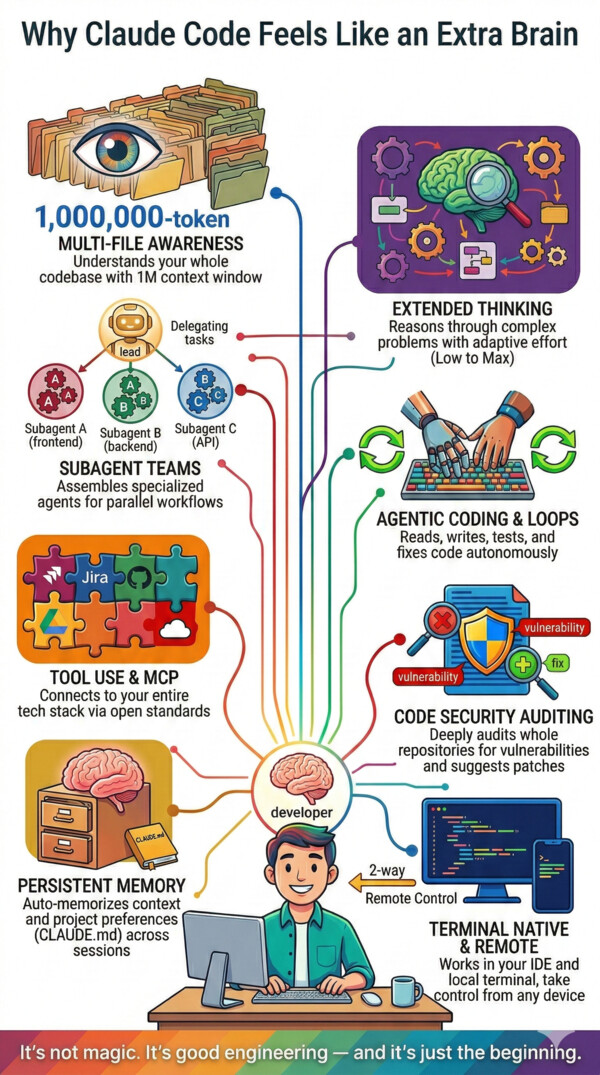
He'd been using Claude Code, which is a different kind of AI to what most people picture. Not ChatGPT, where you ask a question and get a paragraph back. Claude Code sits in your terminal, inside your actual projects. It reads your files. Runs your commands. Makes changes and tests them. It doesn't tell you what to do. It works alongside you.
He used it to diagnose email delivery problems across a set of client domains. Not a vague "here's what you could check" response. A structured breakdown of each domain's specific issues with specific fixes. Missing authentication records. A domain flagged on a blacklist. Bounce addresses that had stopped accepting mail.
Another team member built a workflow for running client site audits. Health checks, DNS lookups, SEO scans, performance reports. All conversational, all from the command line. He shared it with the team and everyone picked it up straight away.
What struck me wasn't the output. It was the adoption speed. Neither of them had used anything like it before. Within a few sessions, they were doing real work with it. Not experimenting. Working.
The gap between asking and doing
Most people's experience with AI is still "ask a question, get an answer." That's useful, but you're still the one doing the work. The AI is a reference book that talks back.
A new category of tools closes that gap. Instead of talking about work, they do it.
You can say "check the SSL certificate on this domain and tell me if anything looks wrong." It runs the check, reads the output, and tells you the certificate expires in three days and here's how to renew it. You can say "find every broken link on this website." It crawls the site, tests each link, and hands you the list.
You stop asking "can I ask it this?" and start thinking "what else can I hand it?"
That's the shift. From AI you talk to, to AI you work with. From a search engine that writes paragraphs, to a colleague that does tasks.
Where to start
You don't have to be technical to try this. There's a natural progression depending on how comfortable you are.
Start with claude.ai. If you haven't used AI beyond a quick Google search, this is the place. It's a website. You type, it responds. But Claude is noticeably better than the free chatbots at reasoning through problems, drafting documents, and working through complex questions. Use it like a thinking partner. Most people are surprised how capable it is once they move past "write me an email." That link gives you a free week to try the full version, including Cowork and Code.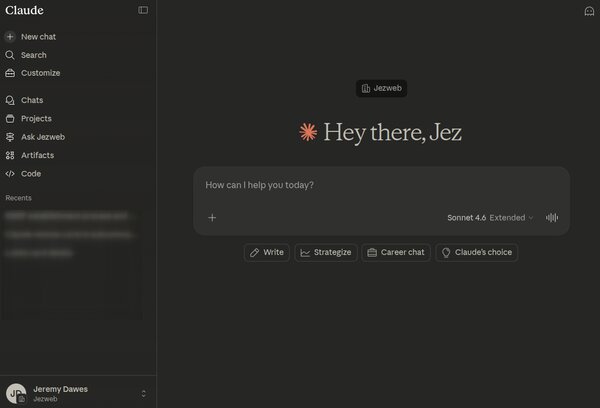 Then try Claude Cowork. Available on Mac and Windows through the Claude desktop app. This is where it goes from answering questions to doing actual work. Point it at a folder of documents and tell it what you need. Organise these files. Summarise these reports. Build a spreadsheet from these invoices. Draft a response to this brief. It plans the work, does it, and shows you the result. No terminal, no code.
If you're technical, Claude Code. This is what our team uses. It lives in your terminal, reads your codebase, runs commands, connects to your systems. OpenAI has its own version called Codex. Google is building similar capabilities into Gemini. This category is moving fast.
Then try Claude Cowork. Available on Mac and Windows through the Claude desktop app. This is where it goes from answering questions to doing actual work. Point it at a folder of documents and tell it what you need. Organise these files. Summarise these reports. Build a spreadsheet from these invoices. Draft a response to this brief. It plans the work, does it, and shows you the result. No terminal, no code.
If you're technical, Claude Code. This is what our team uses. It lives in your terminal, reads your codebase, runs commands, connects to your systems. OpenAI has its own version called Codex. Google is building similar capabilities into Gemini. This category is moving fast.
The point is: you don't have to start at the deep end. Start where you're comfortable and let it prove itself.
It gets better the longer you use it
The thing I didn't expect is how knowledge accumulates.
Every project can have a briefing document that Claude reads before each conversation. What the project is, how it's built, what to avoid, what's already been decided. Write it once and everyone who touches that project starts with full context instead of a blank slate.
When someone discovers a gotcha (a platform quirk, a third-party API that behaves unexpectedly, an email client that strips your formatting), it gets saved as a permanent rule. Claude reads every rule, every session. The whole team benefits from lessons that nobody had to manually pass along.
The longer you use it, the smarter it gets about your business. Not because the AI is learning (it resets each conversation), but because the accumulated instructions and rules make every session more productive than the last.
What this means for your business
If you've tried AI and thought "that's neat but I'm still doing all the work," this is the shift to watch. The capability to go from "AI answers questions" to "AI does tasks" is here and it works.
What separates "interesting" from "indispensable" is whether someone takes the time to connect these tools to your actual systems and write down how your business works. That's not a coding job. It's a knowledge job. And the investment pays off with every person who uses the tool after you.
The extra brain works a lot better when someone's filled it with the right context first.
Away from the keyboard
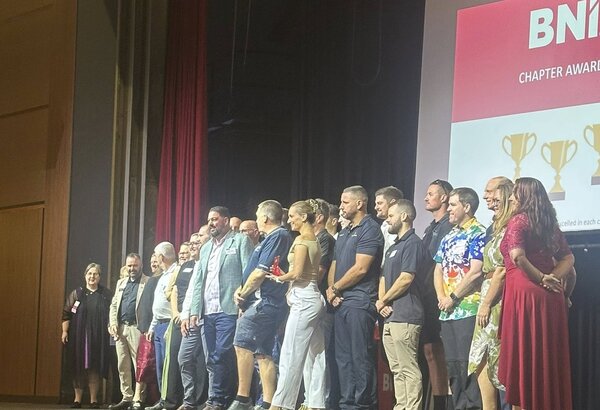
Jezweb picked up an award at the BNI North Awards this year. I've been a member of BNI for over fifteen years and I'm currently Vice President of the Sunrisers chapter. It's still one of the best things I've done for the business. Our chapter passed over $7.1 million in referrals in the last twelve months alone. The referrals are great, but the relationships are what keep you coming back.
If you're in the Newcastle, Lake Macquarie, or Hunter area and curious, visitors are welcome any Friday at 7am at the Blackbutt Hotel in New Lambton. You don't have to join to visit.