Past peak WordPress

I got off the phone with a client who wasn't sure what he'd done wrong. He's been using Claude for all sorts lately and loves it, so he tried to point it at his website to change something. It made a hash of it. His site's built in Elementor, and he wanted to know why the thing that's brilliant at everything else was so hopeless at this one job.
Fair question. It's not that AI can't touch the site. It's that it does an awful job of it, and the reason is worth understanding.
A page builder doesn't save your page as a page. Build something in Elementor and it stores the whole thing as a big blob of builder code in the database, a tangle of settings and structure that really only Elementor knows how to read. Your actual words are buried somewhere inside it. That's not me guessing, it's in Elementor's own documentation: the page is saved as a serialised chunk of data, not the clean HTML you'd expect.
So when you point an AI at it and say "change the phone number", it isn't reading a page. It's rummaging through machine gunk, trying to find your words in the tangle without snapping the layout. It was never built to be read by anything except the builder itself.
And honestly, that's not just an AI problem. It's the same reason editing those sites feels like wading through treacle for a human.
Here's a real one. We moved Hills Tankers, a fuel and dangerous goods carrier that's been running since 1960, off their old Elementor site. I measured the old homepage against the rebuilt one. Same page, same content, same words on it.
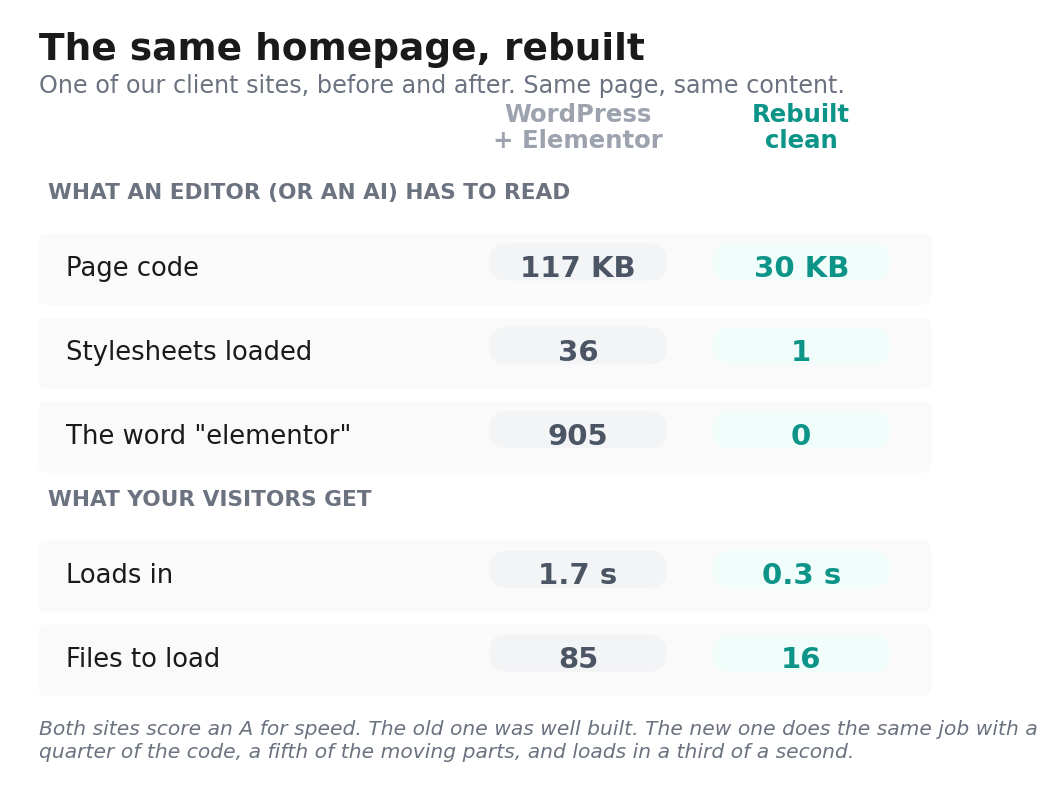
To be fair to the old site, it wasn't slow. It was a well-built page with an A grade for speed. The rebuild is faster still and a fraction of the weight, which is a nice bonus. But speed was never really the point. The point is that all that Elementor scaffolding exists for the builder, not for you, and not for anything trying to read or change your page. Strip it back to a clean page and suddenly an AI can just get in and do the job.

That's the new one, now live at hillstankers.com.au. Same business, same look, clean underneath.
Which gets at something bigger I've been chewing on for a while.
I've spent twenty years in WordPress. It still runs about two fifths of the web, and we still build and host it where it fits. But "anyone can publish" quietly turned into "everyone's a webmaster now." The updates. The plugins. The builder. The backups. The login you use four times a year and dread every time.
The bit nobody said out loud: logging into software to run your website was never the natural way to do it. It was a compromise. The businesses that could afford it never did, they just emailed their web person and said "change this." That's how it always should have worked.
Now it does.
Not a chatbot bolted onto the usual dashboard. An AI team that holds your whole site. You ask for a change in plain English, the same way you'd ask a person.
You can ask in a chat, or by email. Or you can do it on the page itself. You're looking at your own website, you double-click the words you want changed, and you type what they should say instead. You don't have to keep it looking nice while you do it. Making sure it all still hangs together isn't your job.
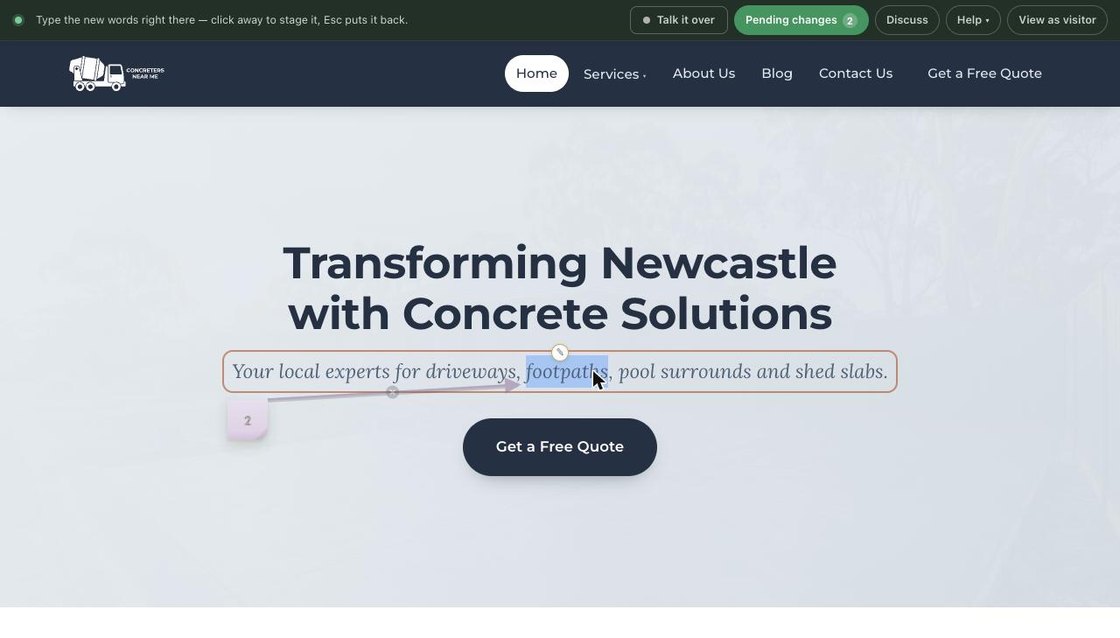
Double-click a photo to swap it. Double-click anywhere else and you get a sticky note you can stick on the bit you mean, with an arrow or a box if that's easier than explaining it.
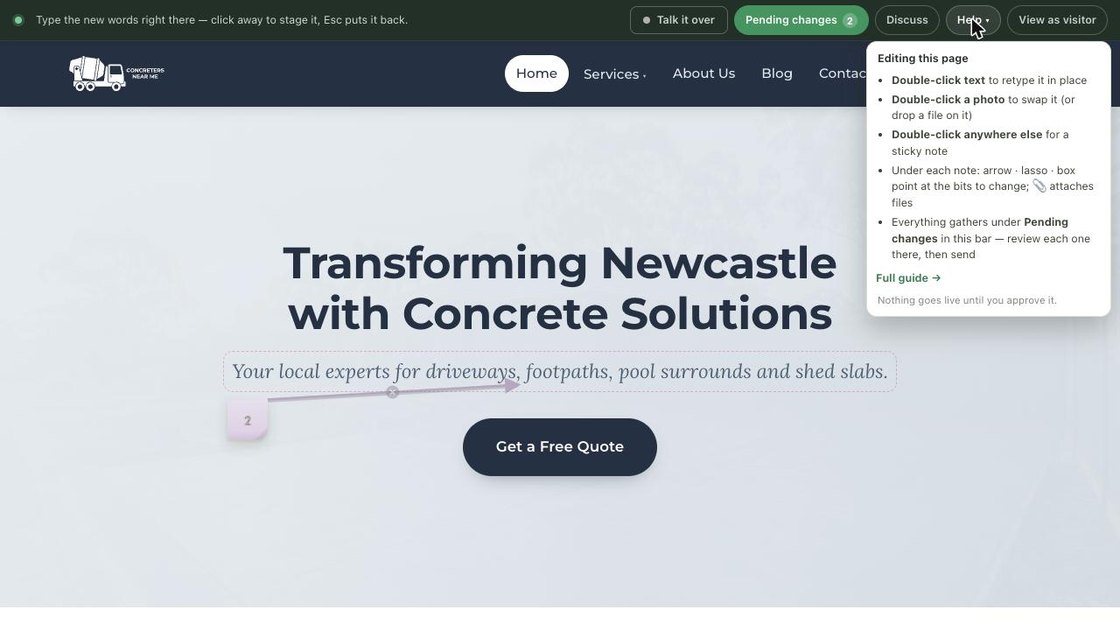
It works like printing the page out and covering it in sticky notes. Nothing goes live while you're doing it, and none of it is you building anything. No wall of menus to pick your way through, no fields to work out, no builder to learn. You're telling your website manager what you want, the same way you'd explain it to the designer who built it.
Each note gets pinned to the spot it belongs to and counted up in the corner. While you work, it's quietly checking behind you. Change something that sits in your footer and it tells you straight away that it's about to change on every page of the site, because you meant all of them, not just the one you were looking at.
When you've marked up everything you want, you send the lot off in one go. It reads every page before it touches one, makes the change on a preview copy, shows you the result, and publishes only when you say yes. No admin panel, no page builder, nothing to break.
And because the site's built as clean pages instead of builder gunk, it can read your site to begin with. That's the whole trick.
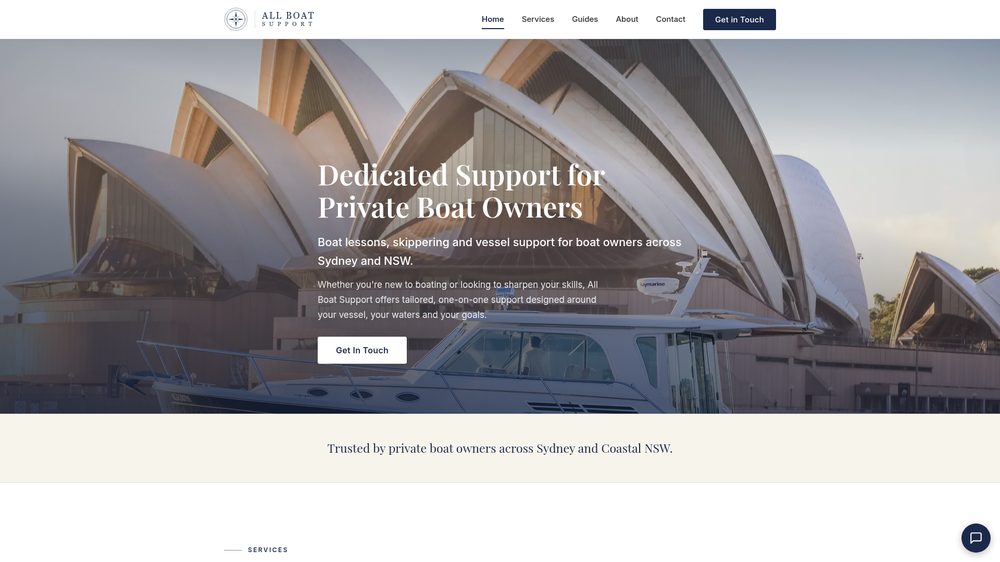
We put a boat business live on it a few weeks ago, All Boat Support. Jordan runs it, and he's already making his own edits, just typing what he wants into the manager chat. His words: as easy as ChatGPT. No login, no builder, no call to us.
Practical bit. A like for like replacement is about an hour and a half of work. A complete build of up to twenty pages is two or three hours. Longer if your site's bigger, or more complicated, or it needs a human to look over it.
If you're on WordPress and you'd like off it, a like for like move is $350 for a site of up to about ten pages. For the first five people who reply to this one, I'll do it for nothing. Have a look at fleetpages.au if you want the detail first.
I won't pretend to know what the web looks like in a few years. It's moving too fast for anyone to call, mine included. But I'm sure of one small piece of it: logging into your own website to wrestle a page builder isn't where this is heading. Asking for what you want, in plain words, and having it done properly, that is. On our sites, it already works that way.
Cheers,
Jez