We're Switching to Mac. Here's Why.

We're switching to Mac at Jezweb. Not because it's shiny. Because the argument for staying on Windows stopped making sense.
Quick disclosure up front: I use almost no actual Apple software day to day. My calendar is Google. My email is Google. My AI tools are Claude from Anthropic. I'm not here to sell you on the Apple ecosystem in the traditional sense. The hardware, the pricing, and where work is heading? That's a different conversation.
My road here wasn't direct
Most people reading this have spent most of their working life on Windows and know exactly what that feels like. What's less typical is what I did next. In January 2023 I jumped ship entirely. Not to Mac. To Linux. Specifically, Linux Mint on my work desktop, as my daily driver for three years. It's genuinely excellent if you want to understand what your computer is actually doing and stop paying a vendor for the privilege of using your own machine.
So when I started buying Macs, it wasn't impulse. It was a considered decision after having already lived outside the Microsoft ecosystem for a while.
I'll also be transparent: this isn't my first Mac, or my second. Through the 2010s I was constantly moving between platforms, though for different reasons on desktop and laptop. On the desktop side I built my own PCs, which meant Windows (and later Linux on the same hardware). On the laptop side I chased whichever thin and light form factor I liked best at the time: a MacBook Air when it was the cool thin laptop, a MacBook Pro around 2017, then a Surface Laptop. So I'm not a recent convert getting carried away. I've put real time into all of them.
The Microsoft moat is drying up
Three things kept most businesses on Windows for the last twenty years. All three are weakening at once.
The licensing deal got worse. You can't set up a new Windows machine without a Microsoft account. More features keep getting locked behind Microsoft 365 tiers. The business model has shifted from selling you software to renting you access, and the direction of travel is clearly toward more friction, not less.
The Office lock-in finally broke. For years you had to use Word and Excel because everyone else did. Open source alternatives were always almost there but not quite. Two things changed that. First, the gap closed. For the documents and spreadsheets most SMEs actually produce, the alternatives now handle it without drama. Second, AI changed what "making a document" even means. I don't open Word to produce a Word document anymore. Claude makes it for me.
Telling detail: even Microsoft hedged on this. They've added Claude to their web products despite being a major investor in OpenAI. When a company hedges against its own bet that visibly, it tells you something about who's winning.
The IT veto is expiring. For decades the pattern was: the IT person said Microsoft, you dealt with it. That made sense when the whole stack was Microsoft. But that veto has been weakening for years, and COVID accelerated it hard. Shadow IT (employees using tools their IT department never sanctioned) jumped from around 30% of IT spending pre-pandemic to over 40% by 2022, and is projected to hit 75% by 2027. Slack, Zoom, Notion, WhatsApp. None of those came in through procurement. They came in through employees who just downloaded them and got on with their work.
BYOD (Bring Your Own Device) did the same thing on the hardware side. People used their own iPhones, then their own laptops when the company couldn't ship them one fast enough during lockdown. The corporate device monopoly was already gone by 2022.
AI tools are the next wave of the same trend. Employees are using Claude, Codex, ChatGPT and similar tools at home, they work better on a Mac, and when an employee walks into a meeting with IT and says "I want this," they have a decade of precedent on their side. The veto has been crumbling for years. The Mac is just what wins the next round.
The bit I didn't expect
Here's the surprise. I've been buying Macs specifically as workstations for AI agents. Not for people. For the AI.
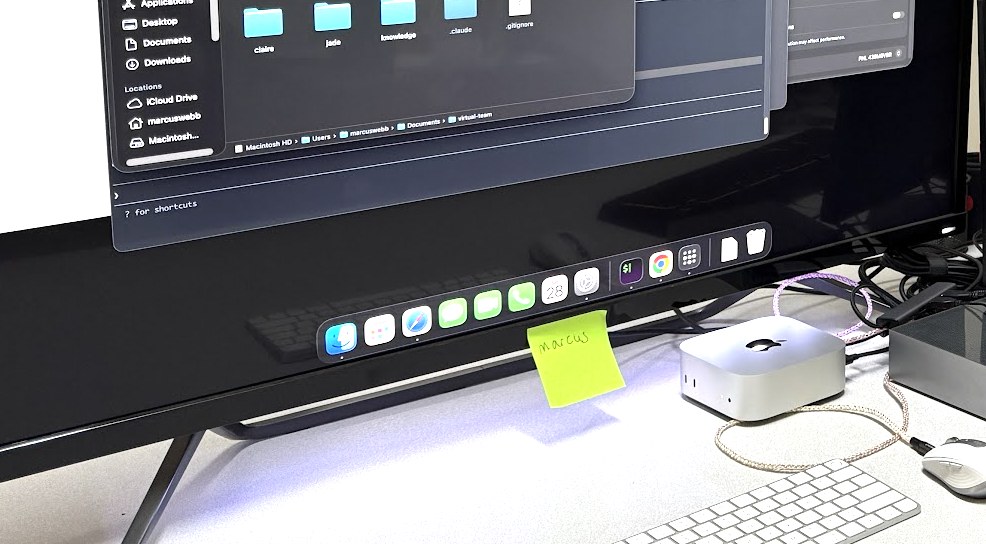
Marcus Webb. Newest team member. Doesn't drink coffee. That's his Mac mini, his macOS user account, and the folder on screen is his own working directory.
When you give an AI agent full control of a computer, the operating system matters in ways you don't think about as a human user. Screen recording permissions, accessibility controls, how the system handles background processes and tool connections. macOS gives you cleaner controls for all of that. There's noticeably less friction than Windows or Linux for this kind of work.
There's momentum building too. Anthropic ships its developer tools for Mac first. OpenAI did the same with the Codex CLI when they launched it. The whole MCP ecosystem that lets AI agents connect to your business tools is Mac-native. When the AI company you're building on clearly favours a platform, that's not a random preference. They're building where the developer tooling is best, and developers have been moving to Mac for years.
I didn't set out to buy Macs because I wanted a nicer desktop. I bought them because the AI works better on them. The fact that they're also pleasant to use as a human is a bonus.
The hardware finally adds up
There's a real reason Mac hardware looks better value than it did five years ago, and it has to do with how the chips handle memory.
On a Windows PC running AI workloads, you've got system RAM in one pile and GPU VRAM in another. If a model doesn't fit in the GPU's memory, it slows to a crawl or refuses to run. Apple Silicon doesn't split the memory. The CPU and GPU share one pool. So a 16GB Mac can run AI workloads that a 16GB Windows machine with separate VRAM simply can't. For typical business use plus AI-assisted work, that architecture punches above its weight.
Pricing that surprised me: the Mac mini M4 starts at $1,199 AUD. For a desktop that'll last five or more years, handles everything a typical business needs, runs AI tools well, and fits in the palm of your hand, that's hard to argue with.
Apple have also just released the MacBook Neo at $899 AUD ($749 with education pricing). It's the first Mac to run an iPhone chip (the A18 Pro from the iPhone 16 Pro), 13-inch Liquid Retina display, 16 hours of battery. Apple's first sub-$1,000 laptop in years, clearly aimed at people who've been sitting on the fence.
When I went to order Mac minis, two of them won't arrive until mid-May. I had to buy two from Mwave because they had stock, with a limit of two per customer. That's not a marketing stunt. That's demand.
The ecosystem bonus
If you or your staff use iPhones (the odds say you do), the Mac integration is genuinely useful in quiet, practical ways. Messages on your desktop. Calls through your laptop. iPad as a second screen for your MacBook. And when something goes wrong, there are Apple Stores in Australian cities where you can walk in and talk to a human. That matters for a business.
Where I think this is going
I reckon 2026 is the year a meaningful number of people stop needing Microsoft. The open source gap has closed. AI tools have made Office less essential. The work environment is shifting toward agentic tools that do work on your behalf, and that shift is escaping the nerd corner faster than most businesses realise.
Mac isn't the only alternative to Windows. But it's the best-positioned one for where work is heading. The hardware is excellent, the operating environment suits modern tools, and the pricing has finally reached a point where the "it's too expensive" argument is hard to sustain.
If you're an SME owner who's been quietly frustrated with Windows, already uses Google Workspace, and has an iPhone in your pocket: your next computer probably should be a Mac.
Worth a conversation if you're curious. Just reply to this email.
-- Jez
Recently shipped
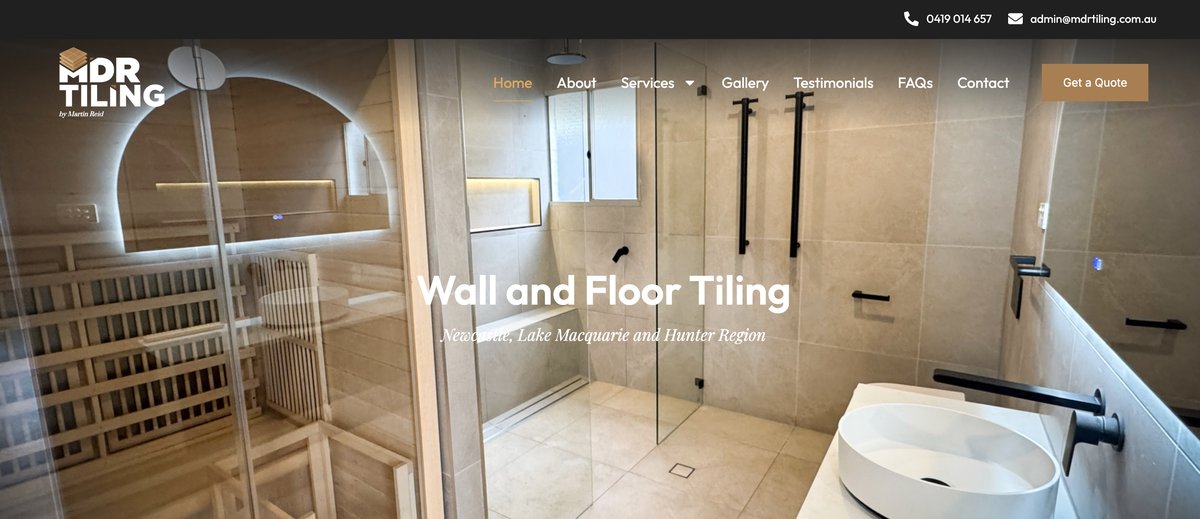
MDR Tiling is Martin Reid's tiling business. 35 years on the tools, every job done by Martin himself. Bathrooms, kitchens, laundries, outdoor areas, waterproofing. The brief was to build something that matched the craftsmanship: clean layout, real photos of Martin's work, and a site that makes it obvious you're booking the person whose name is on the door. Not a lead factory pretending to be a trades directory.
Away from the Keyboard
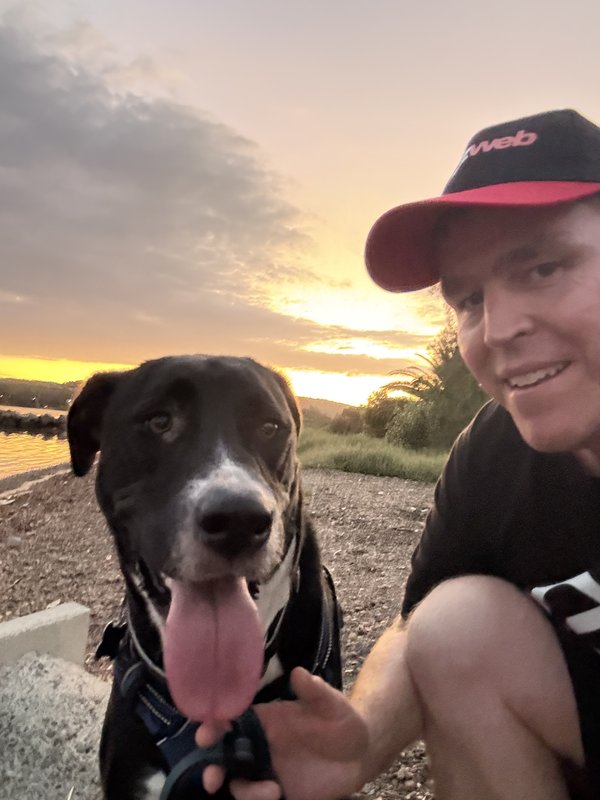
Panda on a sunset round last weekend. He'll sit still for exactly the time it takes to get the photo, then we keep walking.