What fleetpages actually is
Someone wrote back after the last email and asked a fair question: what are you actually building these websites with? He'd read the whole thing and still couldn't tell.
That's on me. I spent a thousand words explaining why AI does a poor job of editing an Elementor site and never said plainly what the alternative is.
So, plainly.
It isn't WordPress. It isn't a page builder.
Your site is built as ordinary web pages, the way sites were before builders arrived. That sounds like a technical detail and it's the whole thing, because a plain page can be read. A page builder's output can't, not really.
Easier to show you. Here's the main heading on the old Hills Tankers site, the Elementor one, pulled off an archived copy of the real page.
<div class="elementor-element elementor-element-2cf7fc0
  e-con-full e-flex e-con e-child" data-id="2cf7fc0"
  data-element_type="container">
 <div class="elementor-element elementor-element-d653362
   elementor-widget elementor-widget-heading"
   data-id="d653362" data-widget_type="heading.default">
  <div class="elementor-widget-container">
   <h1 class="elementor-heading-title
     elementor-size-default">Transporting Australia</h1>
There are three more wrappers above that one. Six in total, 997 characters of scaffolding counting the heading's own tags, to put two words on a screen.
Here's the heading on the site that replaced it.
<h1>Bulk fuel, dangerous goods and liquids
  transport across NSW, Queensland and SA</h1>
That's the lot. No classes, no wrappers, no identifiers.
The numbers aren't really the point though. Look at the names. elementor-element-d653362 tells you nothing about what it is or where it sits. That heading is buried six layers inside a stack of things named after nothing, and every one of them has to be understood before you can safely touch the two words in the middle. That's the job you're handing an AI when you point it at a page builder, and it's the same reason a human dreads it.
On the new one, the heading is a heading.
Then a small AI team looks after those pages for you. Not a chatbot bolted onto a dashboard. A manager that holds your entire site and does the work when you ask for it.
How you ask
Three ways, and you can mix them however suits you.
Email it. Write to your site the way you'd write to the person who built it. "Can you put the new trading hours on the contact page."
Chat to it. Same thing, faster, if you'd rather type in a box and go back and forth.
Or do it on the page. You're looking at your own website, you double-click the words you want changed, and you type what they should say instead. Double-click a photo to swap it. Double-click anywhere else and you get a sticky note you can pin on the bit you mean.
That last one is the part people don't expect. You're not building anything and you're not keeping it tidy while you go. Keeping it looking right isn't your job.
What stops it going wrong
Two things, and they matter more than any of the above.
Nothing goes live until you say so. Every change you ask for gets made on a preview copy first, and you see the result before anyone else can. One of our clients said the preview step was the bit she'd want kept exactly as it is, which I think is the right instinct. It's the difference between asking for a change and gambling on one.
And it checks behind you while you work. Change something that lives in your footer and it tells you on the spot that it's about to change on every page, because you meant all of them, not only the one you were looking at. You didn't have to know that block was shared. It did.
What that looks like on a real site
Hills Tankers run fuel and dangerous goods out of Beresfield, and they've got a public truck wash. When their new wash rates came in, the person who looks after their site updated the whole price list herself, from her own spreadsheet, the day before they took effect.
Thirty-seven prices, across two tables. Prime movers through to road trains, trailers, tyre shine by the tyre, and the internal tank wash rates by category. Both effective-date lines changed too.
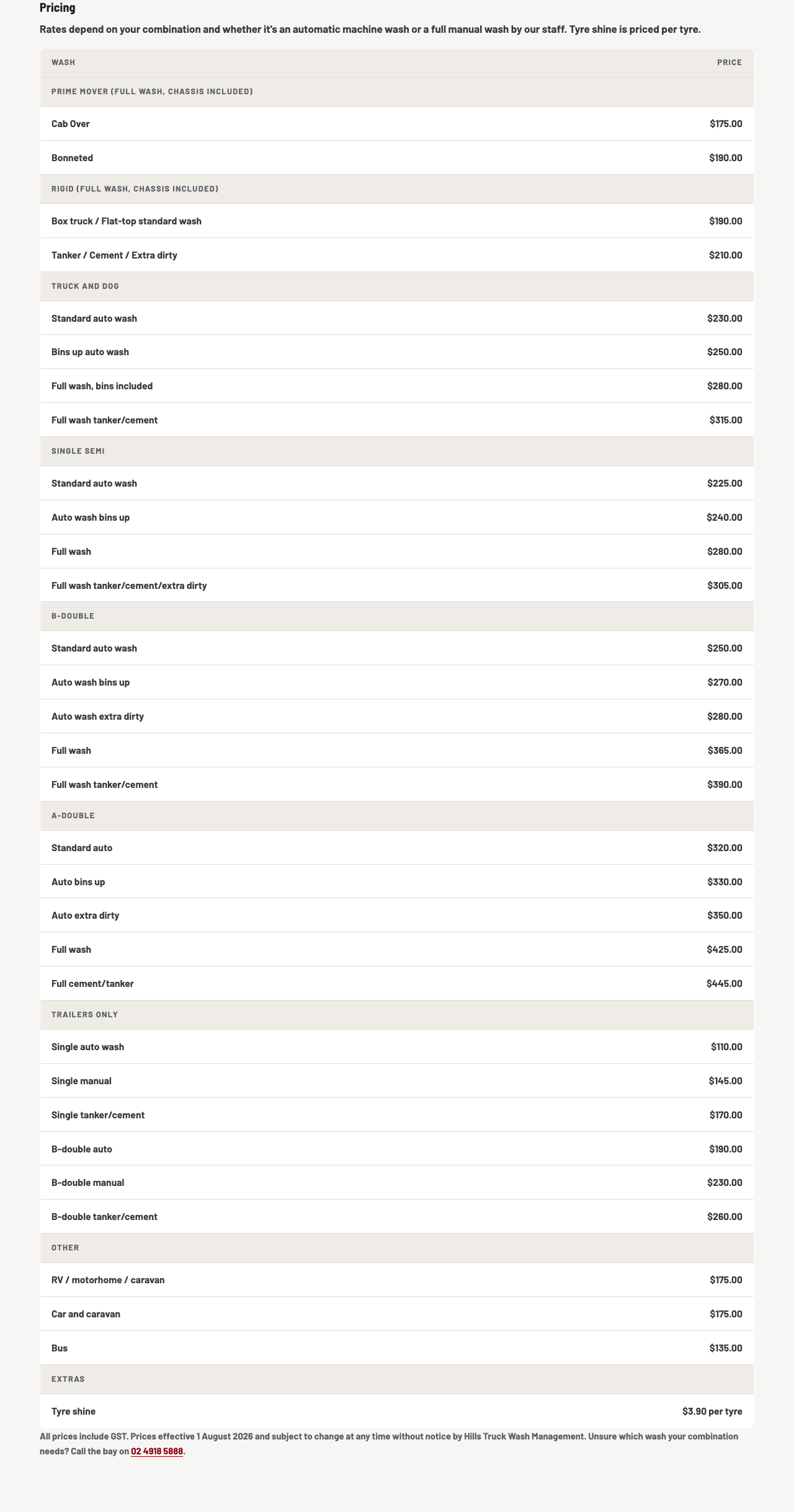
No ticket to us. No developer. No waiting.
Kyra Crawford looks after the site there, and the update took one pass: attach the spreadsheet, check the preview, approve. Her verdict on the whole thing: "Honestly, I feel like a genius updating a website but really it is such a simple process that I feel like anyone could do it."
The list it replaced was current as at December 2023.
That's the bit I'd point at if you only read one paragraph. Not that the technology is clever. That a business stopped needing us for something they'd been putting off for two and a half years.
Jordan at All Boat Support is doing the same, typing what he wants into the chat. His words: as easy as ChatGPT.
Whether it's for you
If you've got a site you're a bit scared of, or one you've stopped updating because it's more trouble than it's worth, this is aimed squarely at you. Same if you've got a price list, a menu, a roster or a set of hours that's older than you'd like anyone to notice.
If you love your setup and it works, keep it. I'm not on a mission to move everyone. We still build and host WordPress where it fits, and it fits plenty of the time.
There's detail on fleetpages.au if you want to poke around, including what a move off WordPress involves and what it costs. If you'd rather ask me, reply to this and tell me what your site is. I'll tell you straight whether it's worth moving.
Cheers,
Jez