Christmas Eve 2024 vs Christmas 2025

If you've been reading this newsletter from the start, you might remember the story I told back in February. Christmas Eve 2024, sitting in front of a browser console full of red error messages, trying to build one simple web page. A Google review link generator. Copy-pasting code from AI, hitting refresh, getting errors. For five days straight.
My screenshots folder from that week: error500.png, argh.png, almost.png, great it worked.png.
One PHP page. Five days. And I was genuinely proud of it.
Christmas 2025
I checked my git history over the break. Here's what it said.
184 commits across 14 projects in seven days.
On December 29 alone, I started four separate repositories: an update server at 12:21pm, an admin dashboard at 3:20pm, an auth server at 6:59pm, and a command-line tool at midnight. By New Year's Eve, all four were connected into a complete platform managing plugin updates across hundreds of WordPress sites.
One of those projects, JezPress (our WordPress plugin distribution system), went from first commit to production in three days. Four repos, authentication, auto-updates, admin dashboard. Working. Deployed. Real clients using it.
The CLI tool went from zero to version 1.3.4 in 48 hours.
I built a family calendar app in a single day just to test whether it was possible. It was.
Same person. Better tools.
I want to be honest about what changed, because it wasn't me. I didn't suddenly learn to code over the course of 2025. I still can't sit down and write a function from memory. If you asked me to explain the difference between a Promise and a callback, I'd have to look it up.
What changed was the tools. Specifically, Claude Code, the AI coding assistant I use a lot. Instead of the copy-paste loop from Christmas 2024 (copy code, paste into file, upload to server, hit refresh, get error, paste error back into AI), I'm having a conversation with an AI that can read my files, run commands, test its own work, and fix its own mistakes.
The difference between Christmas 2024 and Christmas 2025 isn't that I got smarter. It's that the friction between "I know what I want to build" and "it's built" almost disappeared.
The GitHub contribution graph
Here's the bit that still surprises me when I look at it.
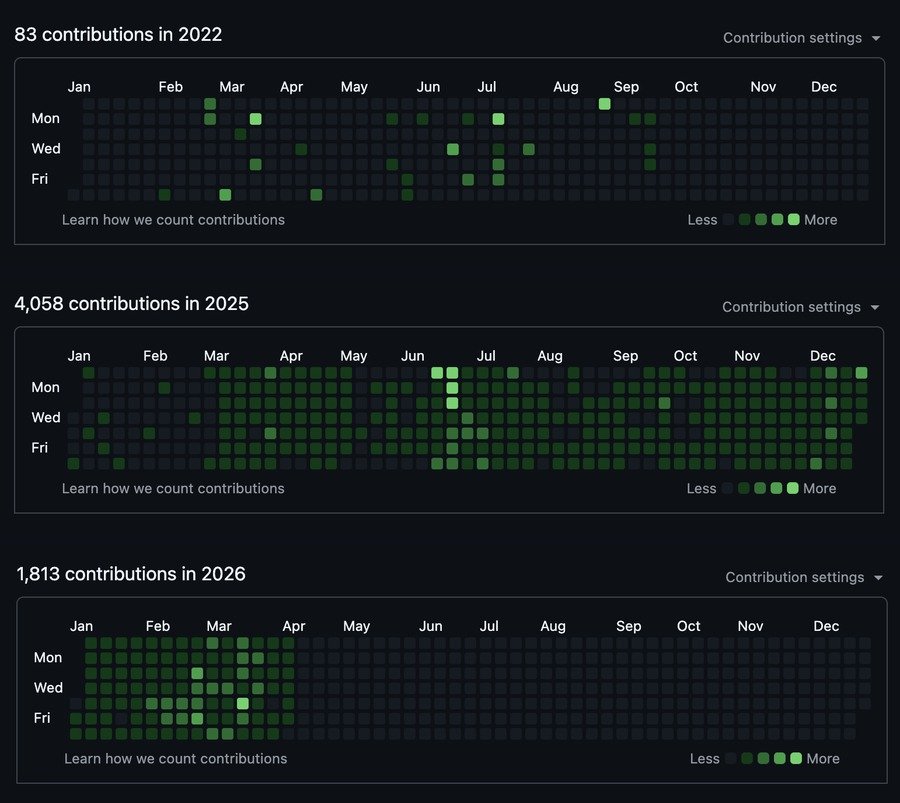
Eighty-three contributions in 2022. Over four thousand in 2025. And 1,813 in 2026 already, barely into April. The green grid tells the story better than I can.
I didn't set out to do that. There was no goal, no challenge, no "commit every day" habit. It just happened because the gap between having an idea and shipping it had become so small that I couldn't stop.
What this actually means
I'm not telling you this to brag about commit counts. What matters is the shape of the change.
In December 2024, building one simple web page was a multi-day struggle. In December 2025, I was shipping complete applications in a day. The JezPress system has authentication, database migrations, webhook integrations, automatic updates, and a CLI. It's more complex than anything I would have attempted a year earlier.
The difference is compounding. Each project creates building blocks for the next one. Every new thing I build makes the next thing faster.
And that's the part I think matters for anyone running a business in 2026. The gap between "I wish this existed" and "I built it" is collapsing. Not just for people who can code. For people like me. People who know their business inside out but never had the tools to build the things they'd imagined.
What this means for your business
This happened to me first because I'm in tech. I was already building when the tools got good. But the gap I described isn't specific to coding.
If you run a business, you've already seen pieces of it. AI writing your emails. AI answering your customer chat at 2am. AI turning a conversation into a spreadsheet, a report, a quote. Each of those is the same pattern: the friction between "I know what I need" and "it exists" is shrinking fast.
What I'm watching happen in our industry right now: custom tools that used to require a development team are becoming something one person can prototype in a day. Not a developer. A person who understands the problem. A tradie who knows his scheduling pain points can describe what he needs and get a working version faster than he'd believe. An accountant who's sick of copy-pasting between three systems can have a proof of concept running by Friday.
I should be honest about where the line is right now though. Getting a working version for yourself is one thing. Making it reliable for your whole team, integrated properly with your other systems, secure, maintained — that's still a different job. The tools get you further than ever on your own, but the distance from "it works for me" to "my business runs on it" is where background knowledge and knowing how to work with AI efficiently still matters. That gap is shrinking every month. It hasn't closed yet. I suspect 2026 is the year it gets close.
I reckon Jezweb is somewhere near the front of this wave, not because we're special, but because we were already in the water when the swell picked up. The businesses that work out how to ride it will build faster, adapt faster, and solve problems their competitors are still waiting on a vendor to fix.
If you read that first Christmas Eve story and thought "that sounds like me," I can tell you: the acceleration from that point is real, and it's faster than you'd expect.
Recently built

Bio Security and Quarantine Compliance is a Newcastle firm doing biosecurity inspections, container and vessel checks, and Approved Arrangement accreditation work for the Department of Agriculture. Niche industry, complex compliance, and the brief was to make it feel approachable without dumbing it down. If you're in import, export, or port operations and need someone who actually understands the DAFF requirements, Martin's your person.
Away from the Keyboard

Panda in his spot. He doesn't care about git commit counts, but he's been in the room for most of them.
If someone you know would get something out of this, feel free to forward it. And just reply if you want to chat — I read every one.